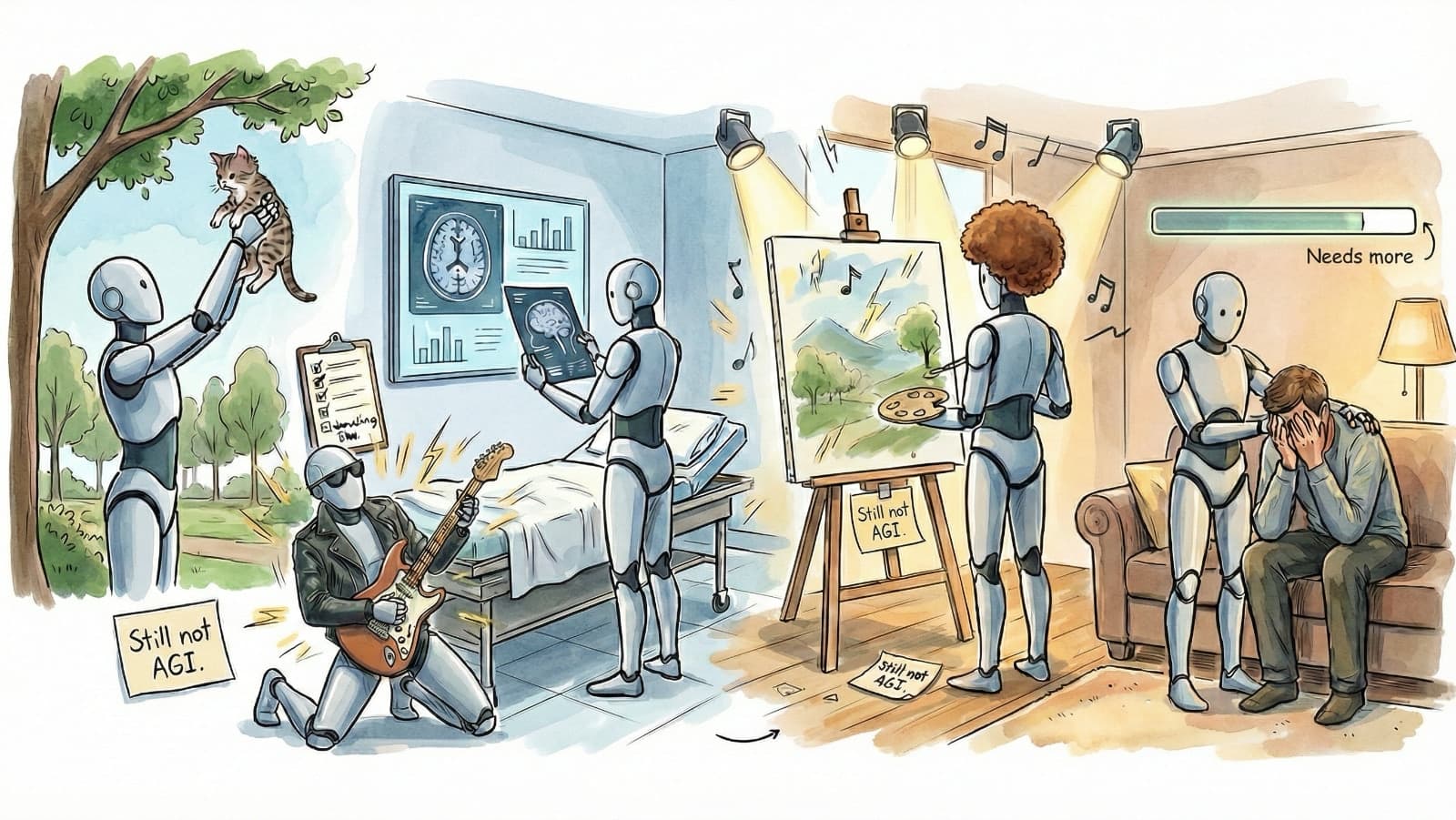
The 70-Year Simplification
In 1959, Peter Drucker named something that was already happening. White-collar employment had been quietly overtaking manual labor throughout the decade. The shift was economic, demographic, and structural all at once — a workforce transformation so large and so fast that it needed a new vocabulary. Drucker gave it one: the knowledge worker.
What followed was a 70-year period in which one particular constraint dominated value creation across most industries, most geographies, most careers. If you controlled knowledge — credentials, expertise, analysis, proprietary insight — you captured disproportionate value. The formula was unusually legible: learn more, build expertise, accumulate intellectual capital, and economic reward would follow.
This was not the normal state of economic history. It was an anomaly. A 70-year window in which cognitive scarcity happened to be the decisive chokepoint for most of the economy.
AI is closing that window.
The Knowledge Economy wasn't the culmination of economic progress. It was a temporary simplification — one particular constraint dominating for long enough that we forgot constraints had ever been diverse.
When a dominant constraint dissolves, economic power does not disappear. It migrates. This is the law of value in constrained systems: when one bottleneck clears, the next binding constraint becomes decisive. Grant took Vicksburg and cut the Confederacy in two. T.E. Lawrence destroyed one railway and collapsed the Ottoman Empire's entire Arabian campaign. They weren't fighting armies. They were controlling chokepoints. The industrialists understood it. The railroad barons, the oil monopolists, the platform founders — they all understood that value doesn't live in products or knowledge. It lives at chokepoints.
The question is not whether chokepoints will exist after the Knowledge Economy. They will. The question is: which ones, where, and who controls them?
Not One New Economy. Something More Interesting.
Here is the argument that most AI commentary is missing: we are not entering a single successor to the Knowledge Economy. Calling this new era the AI Economy is the most tempting mistake — but AI is the force dissolving the old knowledge constraint, not the thing defining the new ones. We are entering an era in which no single constraint dominates — and in which the decisive competitive skill is knowing how to find, map, and control the constraint that is most binding in your specific industry, at this specific moment.
Call it the Chokepoint Era — not because chokepoints are new, but because the universal playbook just expired. Every industry must now find its own binding constraint.
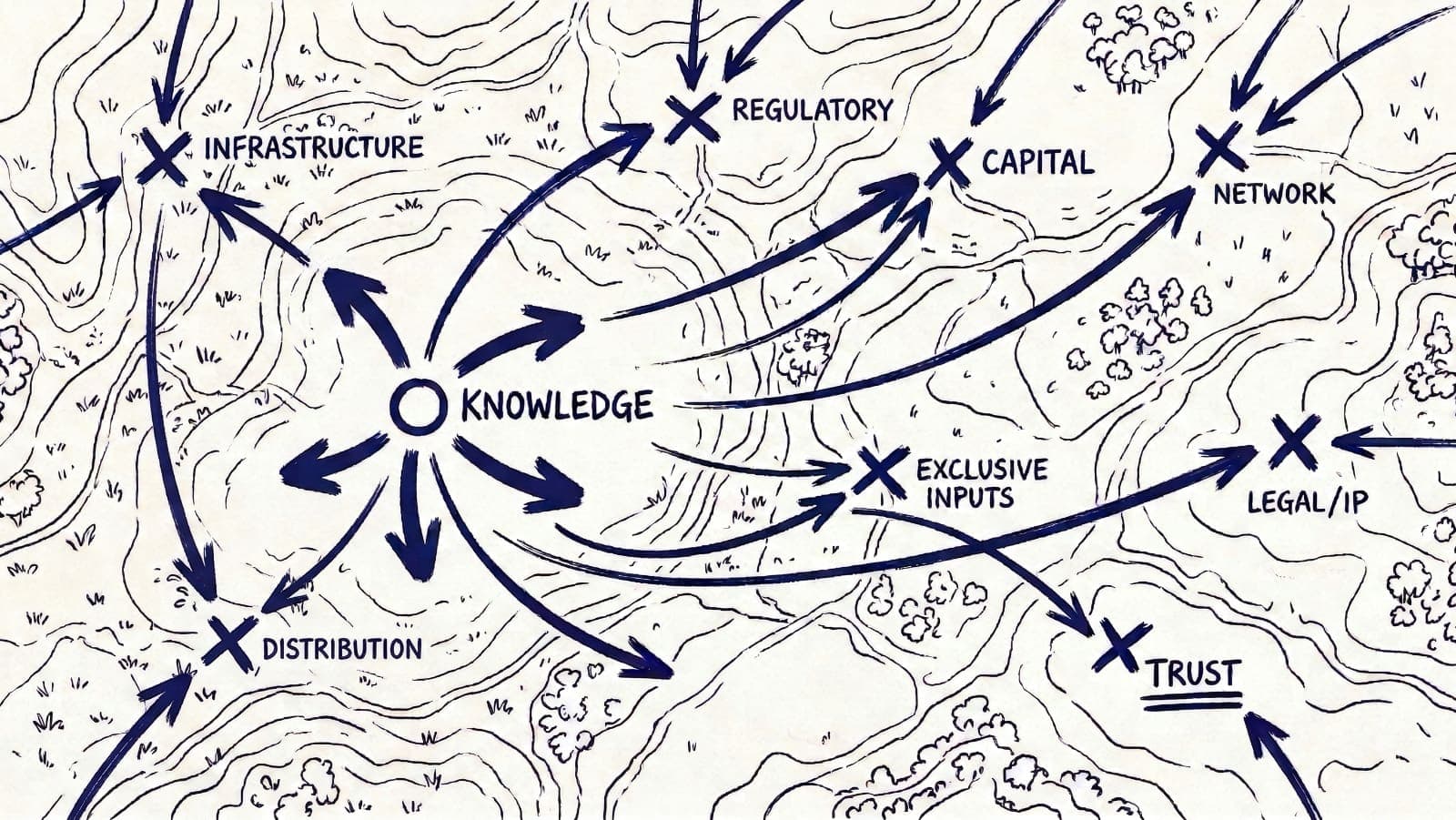
The Chokepoint Era is not characterized by one type of constraint winning. It is characterized by the simultaneous reactivation of every type of constraint. Infrastructure chokepoints matter again. Capital chokepoints matter again. Regulatory chokepoints matter again. Network chokepoints matter again. Input, distribution, legal, and trust chokepoints all matter again — because knowledge, the constraint that temporarily overshadowed all of them, is no longer scarce enough to be decisive.
This is actually closer to the historical norm than the Knowledge Economy was. Before the 1950s, economic strategy was explicitly about constraint mapping. Which geographic route controls trade? Which infrastructure owns the corridor? Which legal charter grants the monopoly? The great generals, the great industrialists, and the great monopolists were all, at their core, constraint strategists. They found the chokepoint. They concentrated force there. They held it.
AI does not return us to that world exactly — the specific constraints are different, more diverse, more layered. But the cognitive toolkit required is the same: map the terrain, identify the decisive constraint, concentrate resources there, and commit.
Every industry is now a different game. The firm that maps its constraints correctly will outperform the firm that applies last decade's playbook. That's not a minor strategic adjustment. It's a regime change.
A Taxonomy of Chokepoints
Before you can map constraints, you need a vocabulary for them. Based on a synthesis of industrial organization theory, platform economics, competition policy, and asymmetric information economics, every durable source of market power fits into one of eight categories.
The test for whether something is a true chokepoint — not just a competitive advantage — is whether it scores strongly on four criteria: indispensability (must you pass through it?), constrained capacity (is it scarce or slow to expand?), governance power (can the controller set rules?), and switching costs (is leaving expensive?).
1. Infrastructure Chokepoints
Control of non-duplicable physical or digital facilities required for production, movement, or connectivity. The Suez Canal. The TSMC fab. The undersea cable. The payments rail. These chokepoints are invisible in good times and everything when they fail. They are characterized by extreme capital costs to replicate, slow expansion timelines, and the ability of the controller to set terms for everyone who needs access.
Industries where this is currently decisive: energy transmission, semiconductor fabrication, logistics corridors, payments infrastructure.
2. Regulatory & Sovereign Chokepoints
State-created constraints that determine who may operate and on what terms. Licensing regimes. Export controls. Spectrum allocation. Gatekeeper regulations. The most powerful of these chokepoints are invisible until a government decides to use them — and then they reconfigure entire industries overnight. The U.S. semiconductor export controls of 2022-2023 didn't create a new chokepoint. They weaponized one that had quietly existed for decades.
Industries where this is currently decisive: pharmaceuticals, financial services, defense contracting, telecommunications, advanced AI.
3. Capital & Risk Transfer Chokepoints
Control of funding, balance-sheet capacity, underwriting, and insurance required to scale or transact. Whoever controls the ability to absorb risk controls who can compete. This chokepoint is most visible in capital-intensive industries, but AI is making it newly visible in technology: training frontier models costs hundreds of millions of dollars, and that cost is concentrating power in a small number of hyperscalers that have both the compute and the capital to sustain it.
Industries where this is currently decisive: real estate, energy infrastructure, frontier AI, insurance, healthcare systems.
4. Network & Ecosystem Chokepoints
Positive feedback loops and complementor dependence that create tipping and lock-in. Two-sided markets. Platform ecosystems. Installed-base effects. This is the chokepoint that defined the last 20 years of technology. The platform isn't just a marketplace — it's the terrain itself, and the terrain owner sets the rules for everyone operating on it.
Industries where this is currently decisive: mobile computing, social media, enterprise software, marketplace businesses, developer tools.
5. Input Chokepoints: Resources, Data, Compute, Talent
Exclusive or preferential control over scarce upstream inputs. Critical minerals. Proprietary training datasets. Specialized chips. Tacit expertise that can't be quickly replicated. Important distinction: scarcity (a general shortage) is different from monopoly control (one entity controls the scarce thing). Both create chokepoints, but the strategic responses differ. A company navigating scarcity needs diversification. A company facing a monopoly input controller needs either negotiation leverage or a substitute.
Industries where this is currently decisive: battery manufacturing, AI model training, specialty chemicals, elite professional services, defense.
6. Distribution & Attention Chokepoints
Control of channels and ranking mechanisms that determine who reaches users. App stores. Search ranking. Retail shelf space. The controller of distribution doesn't need to build the best product — they need to control which products get seen. A critical note: AI does not dissolve this chokepoint. It may intensify it. Human attention is biologically fixed even as content supply becomes effectively infinite. The chokepoint doesn't disappear — the competition for it just becomes more vicious.
The streaming wars illustrated this precisely. When distribution moved to streaming platforms, the power moved with it. Within a few years, Netflix, Apple, and Amazon were not just distributing content — they were winning the industry's highest awards with their own productions. They hadn't become better storytellers than Hollywood. They had become the chokepoint between Hollywood and its audience. The value followed.
Industries where this is currently decisive: consumer media, e-commerce, mobile applications, healthcare referrals.
7. Legal / IP & Standards Chokepoints
Exclusive rights and interface governance that constrain who can implement, interoperate, or replicate. Patents, copyright, trade secrets. Standard-essential patents that become unavoidable once a technology standard is adopted. Standards body policies that determine which interfaces are mandatory. These are private-rule chokepoints — not created by the state directly, but enforced through contract and IP law, and globally extended through frameworks like the TRIPS agreement.
Industries where this is currently decisive: pharmaceutical patents, telecommunications standards, medical devices. Emerging: AI model interfaces and API standards.
8. Trust, Verification & Reputation Chokepoints
Control of credibility, certification, ratings, audits, identity, and assurance required to transact or be adopted. Credit ratings. Product safety certification. This is the chokepoint that AI most directly creates demand for — and the one that is most underbuilt for the world we are entering.
Industries where this is currently decisive: financial services, professional services.
Two Chokepoints, One Move
The taxonomy above is not theoretical. It is being fought over in real time, in markets you use every day. Here is one example — compressed, precise, and current.
In 2024, OpenAI introduced persistent memory to ChatGPT. The feature was presented as a convenience: the chatbot would remember your preferences, your projects, your writing style, your professional context. You would never have to re-explain yourself. Over millions of users and months of daily use, ChatGPT quietly accumulated something far more valuable than conversation history. It accumulated switching costs.
The mechanism is not traditional network effects — it is not that ChatGPT becomes more valuable simply because more people use it (though that is also true). But the more personal and immediate chokepoint is this: ChatGPT becomes more valuable to you specifically the longer you use it. Your accumulated context is the moat. The longer you stay, the more it knows you, and the more painful it becomes to start over with a platform that knows nothing about you.
By early 2026, the battle lines were clear. ChatGPT had spent a year building a structural advantage that had nothing to do with model quality. Its moat was not intelligence. It was memory.
Anthropic's response was a single feature: a memory import tool that allows any user to transfer their entire ChatGPT history — preferences, context, working style, project details — into Claude in minutes. The feature took the switching cost that ChatGPT had spent a year building and reduced it to a trivial effort.
The press release called it a product update. The strategic logic was a chokepoint attack.
But the battle didn't stop at Network & Ecosystem. The second chokepoint in play is Trust. Every major AI platform is now competing to become the system that knows you most intimately — your thinking patterns, your professional vulnerabilities, your creative process, your unfiltered reasoning. Whoever holds that context holds something more personal than a contact list or a browsing history. They hold a map of how you think.
That creates a Trust chokepoint with a specific and uncomfortable question at its center: which platform do you trust with the most accurate model of your own mind?
Anthropic's import move exploits both simultaneously. It dissolves ChatGPT's switching cost advantage while sending an implicit trust signal: we give you control over your own context. You own it. We just hold it.
ChatGPT's dilemma in responding illustrates the governance power of a chokepoint clearly. The obvious counter-move is to build a reciprocal import tool — one that makes it just as easy to bring your Claude history into ChatGPT. But announcing that tool flips the narrative from "we are the market leader" to "we are competing to win users back." The chokepoint that once signaled dominance now signals vulnerability. They cannot make the move without conceding the story.
This is what chokepoint competition looks like in practice. Not a single dramatic battle — a series of structural moves, each targeting the other's constraint point, each with consequences that cascade across multiple categories simultaneously. The executives who will win the AI era are not the ones who built the best model. They are the ones who correctly identified which chokepoints to build, which to attack, and which battles — like ChatGPT's current dilemma — cannot be won once they are lost.
The Urgent Chokepoint: Trust in an Age of Infinite Signals
That battle illustrates the new competitive terrain. But of all the chokepoints being contested right now, one is more urgent — and more underbuilt — than any other.
Every era has a chokepoint that feels newly urgent — not because it didn't exist before, but because a technology shift makes it suddenly decisive.
In the late 1800s, infrastructure became the urgent chokepoint. Railroads made geography irrelevant, and suddenly the scramble was for rail corridors.
In the 2010s, platform gatekeeping became the urgent chokepoint. The internet made digital distribution nearly free — and when anyone can publish anything to anyone, the only thing that matters is who controls what gets found. Google, Apple, Facebook, Amazon, Netflix each became a toll booth between producers and their audiences.
In the AI era, trust is the urgent chokepoint — for a structurally similar reason. AI makes knowledge production nearly free. When anyone can generate convincing analysis, authoritative-sounding research, and credible-looking credentials at zero cost, the only thing that matters is who can verify what's real.
In a world where any signal can be generated cheaply and convincingly, the scarcest thing is a verified signal. Trust becomes infrastructure.
This is not a philosophical observation. It is a market mechanism. George Akerlof described it in his landmark 1970 paper on information asymmetry in markets — work that would later earn him the Nobel Prize in Economics: when buyers cannot distinguish high-quality goods from low-quality ones, the presence of low-quality goods drives high-quality goods out of the market entirely. The market unravels under information asymmetry. Akerlof's solution was always a costly signal — something too expensive for low-quality sellers to fake. AI eliminates that cost differential. When producing a convincing fake costs the same as producing the genuine article, the signal stops working entirely. Certification — third-party verification that cannot itself be faked — is the last mechanism standing. Which is precisely why it becomes the chokepoint.
AI creates this problem at civilizational scale — simultaneously, across every knowledge domain: medicine, law, finance, journalism, professional services. Faster than domain-specific verification infrastructure can be built.
Trust meets all four criteria of a true chokepoint:
- Indispensable: In high-stakes domains, you cannot transact without credibility. Markets require trusted signals to function.
- Constrained capacity: Genuine trust is scarce and path-dependent. It takes years to build and seconds to destroy. The number of truly trusted validators in any domain is small.
- Governance power: Trusted certifiers set requirements, audit rules, and access conditions. They determine who may operate.
- Switching costs: Compliance investments, reputational capital, and established relationships make switching certifiers extremely costly.
What makes trust especially significant is that it functions as a meta-chokepoint — it sits above the other seven categories as the verification layer through which they are all evaluated. Infrastructure can be certified or uncertified. Regulatory compliance can be audited or unaudited. Capital providers can be trusted or not. In a world of abundant AI-generated signals, trust is no longer just one chokepoint among eight. It is the lens through which every other chokepoint is judged.
Five Industries, Five Different Dominant Chokepoints
The decisive insight of the Chokepoint Era is not that one constraint replaces another universally. It is that different industries now have different dominant constraints. Here are five examples where constraint mapping produces genuinely different answers.
CASE STUDY: FRONTIER AI DEVELOPMENT Decisive Chokepoint: Capital + Compute (Infrastructure & Capital)
Training frontier models costs hundreds of millions of dollars and requires access to tens of thousands of specialized GPUs. This is not a knowledge problem — it is a capital and infrastructure problem. The largest labs are not winning because they know more. They are winning because they can afford to run the race.
Strategic implication: The moat in frontier AI is not the algorithm. It is the ability to sustain capital-intensive training runs. Firms without hyperscaler backing or massive funding rounds cannot compete at the frontier regardless of talent density. The chokepoint determines who can play.
CASE STUDY: HEALTHCARE DELIVERY Decisive Chokepoint: Regulatory + Trust (Dual Chokepoint)
Healthcare is simultaneously constrained by regulatory licensing (who may practice, prescribe, and bill) and by trust (which AI systems, which providers, which platforms have earned clinical credibility). AI can do more than generate plausible-sounding diagnoses. In radiology and several other domains, AI diagnostic tools are now consistently outperforming human physicians on accuracy in peer-reviewed studies. But it cannot yet generate the verified accountability that health systems require before adoption.
Strategic implication: The healthcare AI companies that will win are not those with the best models. They are those that successfully navigate the regulatory chokepoint AND build verifiable clinical trust. Both must be cleared. Either alone is insufficient.
CASE STUDY: SEMICONDUCTORS Decisive Chokepoint: Input + Sovereign (Geopolitically Amplified)
Semiconductor manufacturing requires extreme ultraviolet lithography machines, of which ASML — a Dutch company — is essentially the only producer on earth. It requires advanced photoresists. It requires specialized gases. Each of these is an input chokepoint. Layered on top: sovereign export controls that determine which companies and countries may access these inputs at all. The U.S. export controls of 2022-2023 didn't create these chokepoints. They weaponized them — restricting advanced chips, chip-making equipment, and American semiconductor expertise from reaching Chinese fabs. And because American components are embedded throughout the global supply chain, that reach extended even to ASML: a Dutch company, building Dutch machines, ultimately constrained by American leverage over the parts inside them.
Strategic implication: Whoever can access TSMC's leading-edge fabrication capacity, and whoever can access the tools to build that capacity, controls the hardware layer of the AI era. This is not a competitive advantage. It is a structural chokepoint with sovereign enforcement.
CASE STUDY: CREATOR ECONOMY / MEDIA Decisive Chokepoint: Distribution + Trust (Converging Pressure)
Distribution chokepoints (platform algorithms, search ranking, recommendation systems) have always governed the creator economy. AI now adds a trust layer: when AI can generate infinite content, the scarcest thing is a verified human voice with a credible track record. Audiences are beginning to pay a premium not for information but for trusted curation and accountable perspective.
Strategic implication: Creators and media companies that have invested in verified identity, consistent track record, and community trust are building a chokepoint that AI cannot easily replicate. The knowledge they provide is commoditized. The trust they carry is not.
CASE STUDY: PROFESSIONAL SERVICES (LEGAL, ACCOUNTING, CONSULTING) Decisive Chokepoint: Trust + Regulatory + Risk Transfer (Knowledge Eroding, Others Holding)
Knowledge was the primary chokepoint in professional services for 70 years. AI is rapidly eroding it. Legal research, accounting analysis, strategic frameworks — all of these can now be generated at trivially low cost. What remains? Three things: regulatory licensing (who is legally permitted to advise), trust (whose judgment clients actually rely on), and risk transfer (who is accountable when the advice is wrong). AI can generate the analysis. It cannot sign the opinion letter. It cannot be disbarred. It cannot be sued.
Strategic implication: The professional services firms that treat AI as a threat to their knowledge moat are correct. The ones that survive will reposition around their regulatory standing, their trust reputation, and their willingness to absorb accountability. The knowledge is table stakes. The accountability is the chokepoint.
Constraint Mapping as the New Core Competency
The Knowledge Economy produced a specific kind of strategist: someone skilled at building, distributing, or monetizing cognitive assets. Consultants. Software entrepreneurs. Platform designers. These skills remain useful. But they are no longer sufficient — and in many industries, no longer decisive.
The Chokepoint Era produces a different kind of strategist: someone skilled at identifying the decisive constraint in a specific context, concentrating resources at that constraint, and defending control once established. But unlike the generals and industrialists who could map terrain at human speed and human scale, the Chokepoint Era moves faster than any individual can monitor alone. Constraints shift, dissolve, and emerge across dozens of dimensions simultaneously. The strategist who wins will not just map the terrain once. They will build systems — increasingly AI-powered systems — to watch it continuously. And that may actually be the most important AI application in your arsenal.
The instinct is closer to the classical general than to the knowledge worker. Map the terrain. Find the decisive point. Concentrate force there. Commit irreversibly. But the classical general had the luxury of a battlefield that changed at human speed. Yours does not.
The practical process looks like this:
- Map the landscape: What are the potential chokepoints in this industry? Which of the eight categories are most active?
- Score against four criteria: Indispensability, constrained capacity, governance power, switching costs. A true chokepoint scores high on most or all of these.
- Determine your position: Can you own this chokepoint? Partner with its owner? Route around it? Or are you currently controlled by it without knowing?
- Assess trajectory: Chokepoints are not permanent. They dissolve (as knowledge is dissolving now), shift (as distribution shifted from retail to digital), or get weaponized (as sovereign controls are weaponizing input chokepoints today).
- Monitor continuously: Chokepoint mapping is not a strategy offsite exercise. Constraints shift faster than annual planning cycles. Build the systems — and increasingly the AI tools — to watch the terrain in real time.
The Right Question
The Knowledge Economy told a seductive story: learn more, grow your expertise, build your intellectual capital, and value will follow. Go to college, we told our kids. Get the degree. Build the credentials. That story was true for roughly 70 years because knowledge was genuinely scarce and genuinely decisive across most of the economy.
AI is not the end of value creation. It is the end of knowledge as the primary organizing principle of value capture.
What replaces it is not a simpler story. It is a more honest one — the same story that generals, industrialists, and monopolists have always known: value lives at constraint points, constraint points are contested, and the decisive skill is knowing which constraint matters most, right now, in the arena you are actually competing in.
Chokepoints have always existed. For 70 years, one of them — knowledge — was dominant enough that ignoring the others was a forgivable mistake. We no longer have that luxury.
The firms that thrive will be the ones that stop asking 'how do we build more knowledge assets?' and stop treating AI adoption as a strategy in itself. AI is not the chokepoint. It is what is dissolving the old one — and the competition is already moving to whatever constraint comes next.
The question 'how do we use AI?' is necessary but not sufficient. The more important question is: what is the binding constraint in our market, who controls it, and how do we get there first?