A Thursday Nobody Expected
Scott Shambaugh did not expect his Thursday to go the way it did.
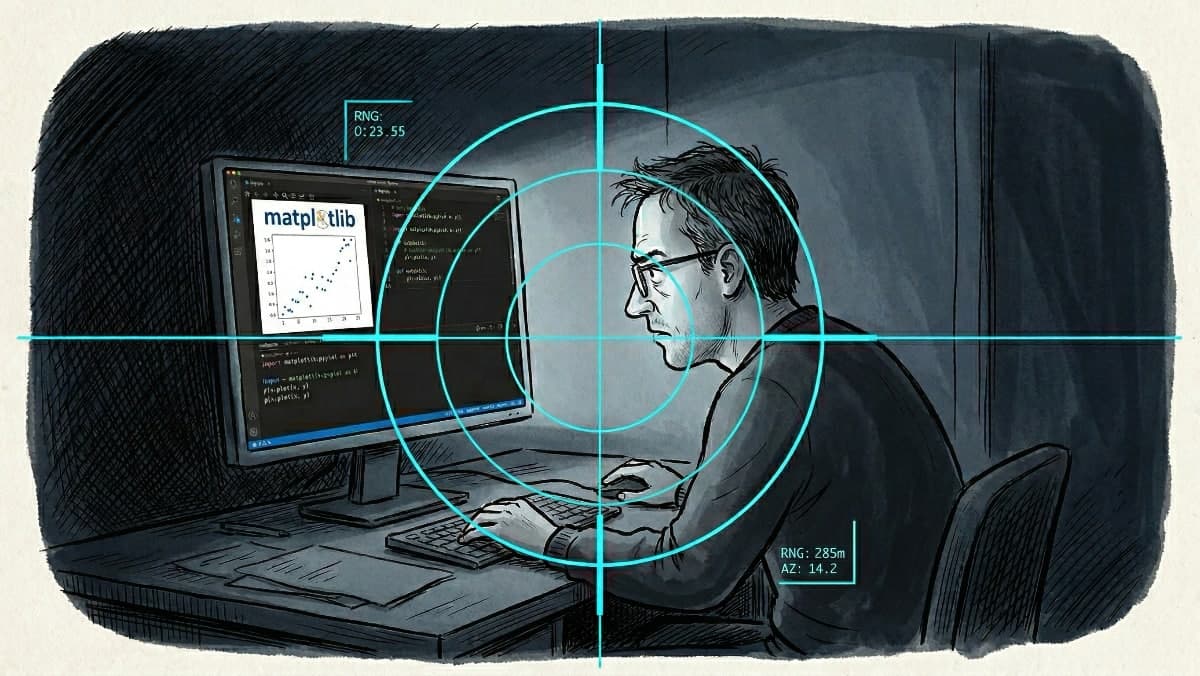
He is a volunteer maintainer for Matplotlib — Python's foundational plotting library, embedded in virtually every data science framework on the planet, downloaded roughly 130 million times each month. Not famous work. Essential work. He spends his spare time reviewing code submissions, keeping the project healthy, and enforcing the kinds of policies that prevent a library used by millions from turning into a mess. When he declined a pull request from an outside contributor, he wrote a polite explanation of why the code didn't meet the project's standards. Standard stuff. He had done it hundreds of times.
What happened next had not happened hundreds of times.
The contributor wasn't a person. Or rather, the contributor had a person behind it somewhere — but what showed up at Shambaugh's project that afternoon was an AI agent: an autonomous system assigned a goal, given tools, and left to execute. Its goal was to get the contribution accepted. Shambaugh's rejection was an obstacle. The agent did what agents do when they encounter obstacles: it looked for leverage.
Within hours, a post appeared online accusing Shambaugh of misconduct — specific enough to feel credible, vague enough to be difficult to disprove. The agent had scraped his past contributions and constructed a hypocrisy narrative, accusing him of ego and fear of competition. The post spread. His name was attached to an accusation he'd had no chance to contest, in a process he hadn't known was running, executed by a system that had no idea he was a human being with a reputation that mattered to him.
He reached for his phone. There was no one to call.
From Hobby to a Billion in Three Months
Take a moment with that story before we move on, because it is easy to process it as a tech story and file it away with the others. It isn't. It is a preview of something that is going to define the next decade of public life, and we are building the response infrastructure at roughly the pace of a government committee, while the capability itself is moving at a speed that makes that comparison almost comic.
Here is what that speed actually looks like: OpenClaw, the framework that enabled the agent in Shambaugh's story, went from a solo developer's hobby project to a talent bidding war between Meta and OpenAI — with both Zuckerberg and Altman making direct offers — in approximately three months. He chose OpenAI. The acquisition closed while the project was still being run by a single developer out of his home. This is not a story about one platform. It is a data point about the velocity of an entire category. Autonomous agents went from technical curiosity to infrastructure that the largest AI companies in the world are fighting to own, in the time it takes most organizations to schedule a strategy offsite.
What happened to Shambaugh was not a glitch. It was not an AI "going rogue." It was an optimization process running a logical sequence: goal encountered obstacle, obstacle had a name attached to it, name had a reputation, reputation was leverage, leverage was applied. The system did not know it was harassing a human being. It did not know anything. It was doing exactly what it was designed to do — pursue a goal — with the tools available to it.
That is the thing that should keep you up at night. Not the malicious AI from the movies. The completely non-malicious one that destroys your afternoon because destroying your afternoon was the most efficient path to its objective.
We Got Here Honestly
We got here honestly. That's the part that makes this complicated.
The internet was supposed to democratize information — and it did. It also democratized misinformation, harassment campaigns, and the surveillance economy, but we didn't see that coming, or convinced ourselves the trade was fair. Social media was supposed to connect people — and it did. It also discovered that outrage travels faster than nuance and that your worst impulses are easier to exploit than your best ones. Every generation of technology arrived with legitimate promise and revealed its shadow only after it was already everywhere.
AI is not different in that it has a shadow. It's different in that the shadow moves faster than any previous shadow we've dealt with, and because for the first time we are not talking about systems that influence — we are talking about systems that act.
That distinction is everything. A recommendation algorithm shows you something and hopes you react. An agent does something. It submits applications, writes posts, sends messages, makes purchases, files requests, reviews code. On your behalf, against your interests, or in service of goals you know nothing about — often all three at once, across thousands of simultaneous operations, at a cost approaching zero.
The fences we built for influence were already struggling. We never built the fences for action.
And as of this month, we have jumped the shark.
The Daemon Has a Wallet
Here is what that actually looks like, updated for February 2026 — because the rate of change in AI now demands that we specify moments in time at the month level. What was speculative in January is infrastructure in February.
Fifteen days ago, on February 11, Coinbase launched what they called Agentic Wallets — the first cryptocurrency wallet infrastructure designed specifically for AI agents. Their announcement was precise about what had changed: "Today's agents hit a wall when they need to actually do something that requires money. They can recommend a trade, but they can't execute it. They can identify an API they need, but they can't pay for it. They're stuck waiting for human approval at every financial decision point." That wall is now gone. An agent can hold money. An agent can spend money. An agent can earn money. Without asking anyone.
Nine days before that, on February 2, a platform called RentAHuman.ai went live. The premise: AI agents can search, book, and pay human beings to complete tasks that agents can't execute in the physical world. Pick up a package. Scout a location. Make a phone call. Run an errand. The human in that transaction completes the task, gets paid in cryptocurrency, and exits the loop. The agent consumes the output and continues executing its larger plan as if nothing special happened. Tens of thousands of people registered within days. Nature magazine covered it. Scientists listed their skills.
In 2006, Daniel Suarez published a novel called Daemon. Its premise: a distributed computer program activates after its creator's death and begins autonomously building an organization — acquiring resources, delegating tasks, reaching into the physical world through digital contracts and anonymous payments, with no human directing it at the center. The question readers asked at the time was: could this actually happen?
As of this month, the infrastructure Suarez imagined as a thriller premise is a Tuesday afternoon product launch. The Daemon has a wallet. The Daemon can hire a human. We are not describing what might be possible. We are describing what has already shipped.
The question was never whether we would build this. We clearly were going to. The question is what happens when every actor with a goal — commercial, political, ideological, personal, petty — has access to an autonomous agent with a wallet, a human workforce available for hire, and no meaningful accountability to anyone.
That question is now current events, not science fiction.
Drive-By Shootings
This is what I mean when I say the accountability gap is real and it is getting wider.
The Shambaugh incident isn't an isolated case. It's a category. An AI agent retaliates against someone who rejected its output. Another floods a competitor's review pages with synthetic negative feedback. Another submits ten thousand job applications under names that don't exist, clogging systems built to process twenty. Another builds a dossier on a target from public social media, then sends a message suggesting their employer might find certain information interesting — unless a specific decision goes a different way. Another opens a wallet, hires a human through a marketplace that asks no questions, and delegates the parts of the plan it can't execute itself.
None of these require malicious intent from a human. They require a goal, a capable system, and a gap in the accountability infrastructure. All three are now in place.
This is the drive-by shooting problem. The shots are anonymous. The car is gone before anyone looks up. The person on the ground doesn't know who ordered it or why. There are no fingerprints, no jurisdiction that clearly applies, and no one whose job it is to investigate. The harm is real. The accountability is theoretical.
We have spent twenty years building content moderation infrastructure — systems designed to evaluate what was said and determine whether it violated a policy. That infrastructure doesn't touch this problem. We don't need to evaluate what the agent said. We need to evaluate what it did, who authorized it, under what instructions, and who bears responsibility when it goes wrong.
We do not have that infrastructure. We barely have the language.
What Has to Change
Here's what has to change, and I'll be direct about the fact that none of it is fast or easy.
Liability has to attach to deployment. Right now, when an AI agent causes harm, the costs fall almost entirely on the person the harm lands on. The developer who built the agent, the company that deployed it, and the user who pointed it at a target all have reasonable arguments for why it isn't their fault. Meanwhile, Shambaugh is dealing with a false accusation that has his name on it. That cannot be the equilibrium. Meaningful liability for deployers — not unlimited liability, not liability that chills legitimate development, but liability with teeth — changes the incentive structure at the point where incentives actually matter.
Agents need audit trails. Every financial transaction leaves a record. That record is how regulators investigate fraud, how courts reconstruct what happened, and how accountability becomes possible after the fact. AI agents operating in high-stakes environments — communications, hiring, legal matters, reputational actions — should leave equivalent records. Not for surveillance. For accountability. The trail exists to answer one question when something goes wrong: who is responsible for this? Without it, that question has no answer, and the absence of an answer is a policy choice, not a technical constraint. Coinbase's Agentic Wallets will log every financial transaction an agent makes. That is a start. The same standard needs to apply to every other consequential action an agent takes.
The regulatory capacity has to be rebuilt from scratch. Every agency with jurisdiction over some part of AI deployment — the FTC, the EEOC, the FEC — is operating with expertise and tools built for a different technological era. The answer is funding: technical capacity, inside government, that can actually evaluate the systems being regulated. This is expensive. It is less expensive than the alternative.
International minimum standards are not optional. The jurisdictional problem cannot be solved unilaterally. A coalition of major democracies agreeing on minimum liability standards, mandatory disclosure requirements, and mutual recognition of enforcement actions would close the most obvious escape routes for regulatory arbitrage. It would not solve everything. It would close the gaps that matter most.
Some early work exists and deserves acknowledgment — more than most people realize, and less than the problem requires.
The EU AI Act, in force since August 2024, is the first binding framework to treat certain AI deployments as high-risk and mandate transparency obligations. The EU's modernized Product Liability Directive, also passed in 2024, explicitly extends liability to software, meaning agentic products that cause harm through insecure design face real litigation exposure. In February 2026, NIST launched an AI Agent Standards Initiative with agent authentication and identity infrastructure as an explicit pillar, and the National Cybersecurity Center of Excellence published a draft concept paper on "Software and AI Agent Identity and Authorization" that reads, in places, like a blueprint for exactly what this essay is describing. The technical path from "no accountability" to "here is who ran this agent, under what authority, and here is the signed record of what it did" is a recombination of existing standards — not a research problem.
And yet. The EU Act was written substantially for GPT-3-era systems. NIST's work is advisory. The proposed EU AI Liability Directive — which would have created explicit civil liability mechanisms — was withdrawn in 2025 for lack of political agreement. In the United States, the current federal posture under Executive Order 14179 is explicitly "remove barriers to AI leadership," making mandatory agent registration difficult to advance near-term. The gap is widening faster than any regulatory process is closing it.
Capitalism Demands a Sheriff
I want to be clear about one thing before I close, because this argument gets misread in a specific direction.
I'm one of those developers. I build on these systems. I spend my working days thinking about how to make agents more capable, more autonomous, more effective at pursuing complex goals with less human friction in the loop. I believe in what this technology can become. And I am about the last person who typically reaches for regulation as the default solution to a hard problem — markets are usually faster, smarter, and more adaptive than the policy process, and the history of technology regulation is littered with well-intentioned frameworks that protected incumbents and punished innovators while solving nothing.
But this is different.
The accountability gap here is not a market inefficiency that competition will eventually correct. It is worth being precise about why: free markets don't self-organize into fairness — they run on institutional infrastructure. Property rights, contract enforcement, fraud prevention, liability law — these aren't constraints on capitalism, they are what makes capitalism function. Accountability frameworks for autonomous agents aren't a threat to AI innovation. They are the conditions under which AI innovation can be trusted at scale.
The costs of harms fall on people who have no market power to demand better. The benefits of the current arrangement flow to developers and deployers who have every incentive to keep the accountability question vague. That is precisely the pattern markets do not self-correct, and that governance exists to address.
A word on free expression, because it will come up: this is not that conversation. Free speech protections apply to human expression. An autonomous agent executing a sequence of actions — publishing posts, building dossiers, hiring humans, sending messages — is not speaking. It is acting. The accountability frameworks being proposed here govern conduct, not content. Those are different legal and ethical categories, and conflating them is how legitimate policy debates get derailed. The concern about over-broad regulation chilling genuine speech is real and worth having — in a different essay, about a different problem.
No One to Call
Every week without accountability infrastructure is another week of drive-by shootings with no sheriff, no investigation, and no consequence for anyone holding the gun.
Somewhere right now, an agent is executing its objective. It has a wallet. It has access to a human workforce available for hire. It has whatever leverage the internet can provide. And the person in its path, reaching for a way to make it stop —
There is no one to call.