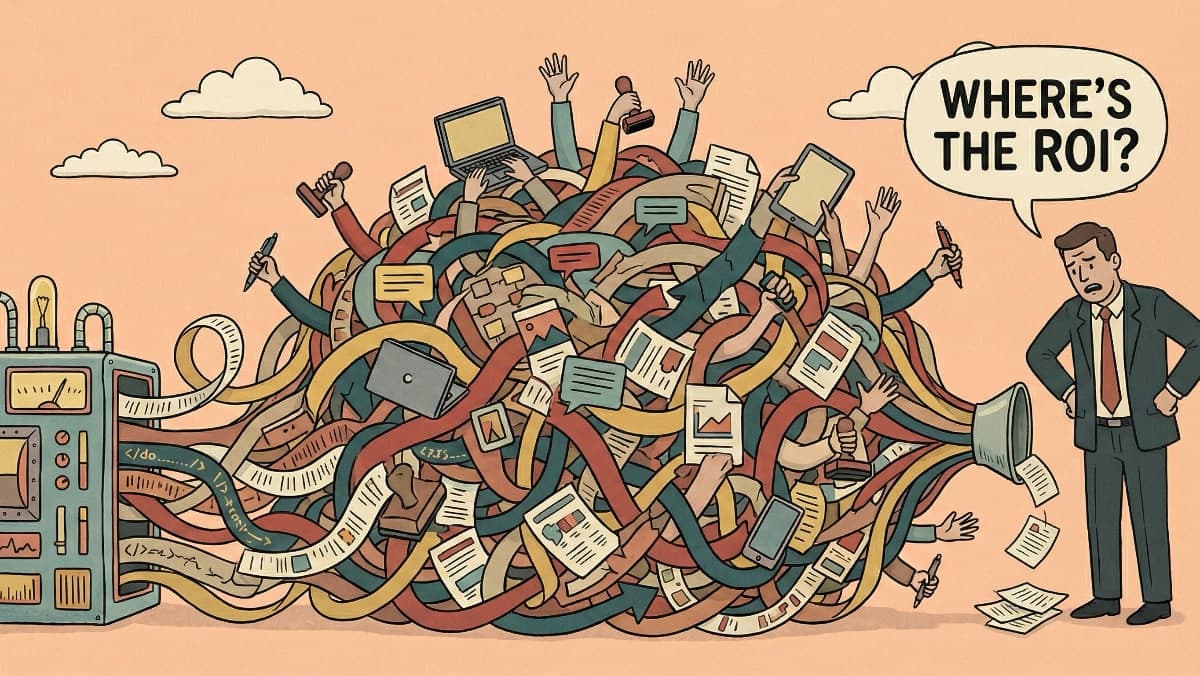
At first glance, the data seems to be getting worse. MIT’s NANDA report found that 95% of enterprise AI initiatives—representing $30–40 billion in investment—have delivered zero measurable ROI. BCG found that 74% of enterprises struggle to achieve and scale value from AI. An NBER study across four countries found the vast majority of executives see little operational impact. And HBR just reported that employees using AI are working more hours, not fewer.
The usual explanations aren’t wrong. Bad data. Broken processes that AI automates at higher speed. Non-strategic deployments—someone AI’d the coffee pot while the product pipeline stayed manual. Every consulting firm has a deck about these.
But I keep hearing phrases that point to something different. “Our product team is writing specs three sprints ahead of engineering.” “QA is completely underwater—the dev team is coding faster than we can validate.” “We’ve got more PRs open right now than we shipped all of last quarter.” “We generated forty architecture proposals last month. We reviewed six.”
These phrases all scream higher productivity. More specs. More code. More PRs. More output at every stage. So how can both be true? How can teams be measurably more productive and yet, business results stay flat?
There’s a deeper problem—and it may be the biggest and most hidden driver of disappointing AI returns. AI is accelerating the wrong parts of the system.
This isn’t a technology problem. It’s an operations problem. And operations solved it forty years ago.
The Knowledge Bottleneck
In the 1980s, Eliyahu Goldratt wrote The Goal, a book that transformed manufacturing by articulating the Theory of Constraints. The core insight is deceptively simple: every system has a bottleneck—a single point that limits total output. Improving efficiency anywhere other than the bottleneck doesn’t increase output. It just increases the pile of unfinished work sitting in front of the bottleneck.
Resistance to this idea is immediate, which is what kept manufacturing inefficient for decades. Surely making any part faster helps? It doesn’t.
AI has turned knowledge work into a factory—and most organizations haven’t noticed.
To make this concrete, consider software development—the knowledge industry where AI adoption is furthest along and the dynamics most visible. The same pattern applies to legal, consulting, financial services, and any organization where thinking is the product. But software makes the clearest case.
For decades, software development was naturally balanced. Product managers wrote specs at human speed. Engineers coded at human speed. QA tested at human speed. The whole system was constrained by cognition, and because that limit applied everywhere, the stages moved roughly in sync. You didn’t see piles of finished specifications waiting months for engineering, because specs couldn’t be written much faster than code.
Then AI arrived, and the equilibrium shattered.
Knowledge work is piling up as inventory. For the first time in history, operations theory fully applies to thinking systems.
Specs drafted in minutes instead of days. Code expanding exponentially in a week. Documentation multiplying effortlessly. Feature branches proliferating. For the first time at scale, knowledge work is accumulating as inventory—unvalidated, unintegrated, and depreciating.
I’ve written separately about what I call Knowledge Inflation—the idea that when AI makes knowledge work abundant, the per-unit value of that work declines, just as monetary inflation devalues currency. But inflation is only half the story. The other half is what happens when that flood of devalued output hits a system that can’t absorb it. That’s the knowledge bottleneck—the operational mechanism that turns Knowledge Inflation into negative ROI.
If the bottleneck hasn’t moved, that inventory isn’t becoming output. It’s just piling up.
How to Tell If This Is Your Problem
Not every AI ROI failure fits this pattern. If your teams aren’t adopting the tools, or if AI outputs are too low-quality to use, those are different problems. But if you’re seeing these symptoms, you likely have a knowledge bottleneck:
Your backlogs are growing, not shrinking. More branches open. More documents “in review.” More proposals waiting for decisions. More analysis sitting unused.
Teams report being busy, but shipping hasn’t accelerated. People feel productive. AI usage metrics look great. Time-to-market hasn’t budged. This is consistent with what HBR found: AI users are working at faster pace, broader scope, and longer hours—yet the output that matters isn’t moving faster. The intensity is real. The throughput gains aren’t.
Review and approval stages are becoming chokepoints. QA cycles lengthening. Architecture review overwhelmed. Executive decision-making the new complaint. Senior people drowning while junior people have capacity.
Work is aging. Code sits in branches for weeks. Documents become outdated before they’re approved. Analysis goes stale before decisions are made. You’re refreshing context on work done weeks ago—which is its own special kind of productivity.
AI adoption is high, but output metrics are flat. Lots of AI-generated content being produced. Deployed features, shipped products, finalized decisions, revenue? Not so much.
If this sounds familiar, you’ve used AI to build yourself a bottleneck.
Cognitive Overproduction
In a physical factory, inventory accumulation is a familiar problem. If machining runs faster than assembly, parts pile up. Operations managers have spent a century learning to spot this.
Knowledge work historically didn’t behave that way. Every stage moved at a similar pace because they were all limited by human throughput. There was no such thing as cognitive overproduction, because creation and integration were coupled by the speed of thought.
AI has broken that coupling.
Specifications are written faster than they can be validated. Code generated faster than it can be reviewed. Features designed faster than they can be integrated. Analyses produced faster than decisions can be made.
AI isn’t just revealing bottlenecks that were always there. It’s manufacturing new ones.
The bottleneck cascades. AI accelerates code generation, so QA becomes the chokepoint. You throw AI at test automation, and architecture review can’t keep pace. You streamline architecture review, and the release engineering team—integration, deployment, production readiness—becomes the constraint. Nothing ships faster until every stage can keep up. It’s a game of whack-a-mole, except the moles are getting faster.
And the constraint doesn’t sit still. In one sprint, testing is the bottleneck. Next sprint, architecture review. The month after, executive decision-making. The constraint migrates as conditions change—harder to find, easier to misdiagnose.
Knowledge Inventory Is Frozen Capital
Here’s the financial reality. In a factory, inventory on the warehouse floor is money in physical form—capital sitting idle instead of generating returns. CFOs understand this intuitively. They track inventory turns and push for lean operations because inventory is frozen capital.
Knowledge inventory works the same way. Every unused specification, design document, feature proposal, code branch, or AI-generated report represents labor cost stored in text. Salaries paid. Compute consumed. AI subscriptions billed. All of it embedded in documents sitting in queues, waiting to become revenue.
But knowledge inventory is more dangerous than physical inventory, because knowledge decays.
Your organization is paying to produce assets that depreciate faster than they can be deployed. That’s not a technology problem. It’s a capital allocation problem.
Steel beams in a warehouse remain steel beams. A specification written three months ago may already be wrong. Markets shift. APIs change. Architecture evolves. Dependencies update. Teams reorganize. Knowledge has a half-life, and in fast-moving industries, that half-life is measured in weeks. Knowledge inventory doesn’t age like steel. It ages like bananas.
Unintegrated knowledge spoils. The longer a document sits, the more expensive it becomes to revive—context reloaded, assumptions revalidated, technical details updated, decisions relitigated because the people involved have moved on. It’s not just idle capital. It’s rotting capital.
The carrying cost includes cognitive reload, coordination friction, and architectural drift. Physical inventory ties up capital. Knowledge inventory actively destroys it.
Same Throughput. Higher Costs. Negative ROI.
This is the mechanism. AI dramatically improves drafting, coding, research, documentation, and analysis—production activities. It does not automatically improve architectural coherence, risk judgment, testing depth, organizational alignment, decision bandwidth, or executive clarity—integration activities. The work of turning raw production into validated, revenue-generating output.
Accelerate production without accelerating integration and the math is straightforward: AI costs go up. Work-in-progress goes up. Carrying costs go up. Validated output—features shipped, decisions made, revenue generated—stays flat, governed by the integration constraint that hasn’t changed.
Higher costs. Same throughput. Negative ROI. Exactly as constraint theory predicts.
The Leadership Trap
Leaders see swelling backlogs and reach for the obvious lever: we’re overproducing. Cut product managers. Reduce headcount. Slow down.
Wrong lever. If production is not the constraint, reducing it doesn’t increase throughput. It slows inventory accumulation. That might feel like progress. It isn’t.
Worse, organizations frequently misidentify the constraint itself. Cut senior integrators—staff architects, QA leads, release engineers, executive decision-makers—and you reduce the one thing that was actually limiting output. Inventory is visible and measurable. Bottlenecks are invisible and hard to quantify. That asymmetry leads to systematically bad decisions: cutting the roles that govern output because you can’t see what they constrain, while preserving the roles that pile up inventory because you can see their output.
We’ve shifted from a production-limited system to a judgment-limited system. Most leadership teams haven’t recognized it yet.
Before AI, the constraint was production—people could only think and type so fast. After AI, the constraint has shifted to judgment, coherence, integration, risk management, and decision-making authority. Most leadership teams haven’t noticed. They’re still optimizing for production speed—precisely the mistake Goldratt spent a career warning about.
The Illusion of Productivity
This shift creates a dangerous illusion. Activity increases. Documents multiply. Code expands. Dashboards glow. Everyone feels busy—and as HBR confirms, they genuinely are busy. Working harder than ever. The work is accumulating, not completing.
Throughput—validated, integrated, value-delivering output—doesn’t keep pace. Local efficiency improves while system efficiency stagnates.
Speed without synchronization is not acceleration. It’s congestion. It feels like progress. It shows up in financial statements as disappointing returns.
What a Constraint-Aware Response Looks Like
A composite example. A mid-size SaaS company deployed AI coding assistants across engineering. Within three months, pull request volume tripled. The team was thrilled. Release cadence didn’t change. The QA team—sized for the old world—became the bottleneck. Code sat in review queues for weeks. Bugs shipped because reviewers were rushing. Customer satisfaction declined. The AI was working perfectly. The system wasn’t.
The company’s instinct was to restrict AI usage—slow down production. Instead, they mapped their workflow and measured where work was waiting. Three constraints: QA capacity, architecture review bandwidth, and a product approval process requiring sign-off from two executives who met biweekly.
They redirected AI investment toward the constraints. AI-assisted test generation tripled QA’s effective capacity. AI surfaced architectural conflicts earlier in development, reducing the review burden on senior architects. AI-generated impact summaries replaced 20-page feature proposals, cutting executive decision time in half. They implemented WIP limits—no team could have more than two features in active development.
Within two sprints, release cadence doubled. Not because they produced more code, but because validated output flowed through the system. ROI turned positive—not by generating more, but by unblocking what was stuck.
What to Actually Do
Constraint theory prescribes a disciplined sequence: identify the constraint, exploit it, subordinate everything else to it, elevate it, repeat.
Find where work actually stalls. Measure cycle times through each stage. Track where work sits waiting, not where it’s being processed. The constraint is often not where you expect: a biweekly approval meeting, a single architect, a compliance review that takes six weeks. Because constraints shift, this is an ongoing practice, not a one-time audit.
Tie AI generation to integration capacity. If QA can validate ten features per week, don’t generate twenty. If executives can make five strategic decisions per month, don’t produce fifteen strategy memos. Subordinating production to the constraint means deliberately producing less. It also means what you produce actually ships.
Invest AI in elevating the constraint itself. This is the highest-leverage move and where most organizations underinvest. If testing is the bottleneck, focus AI on test generation. If architecture review is the constraint, use AI to surface integration conflicts earlier. If decision-making is the constraint, deploy AI for scenario analysis that compresses what executives need to act. Don’t use AI to generate more options—use it to make the bottleneck faster.
Implement WIP limits and flow metrics. Cap parallel initiatives, branches, and pending documents. Measure aging. Force work to completion before starting new work. Any knowledge inventory sitting untouched longer than its useful half-life should be triaged: complete it, update it, or kill it.
Do not optimize production volume. Optimize flow. ROI comes from validated output, not activity metrics.
The Bigger Implication
When knowledge production was slow, scarcity disciplined organizations. Limited capacity forced prioritization. You couldn’t write twenty strategy memos because you only had time for three, so you chose the three that mattered.
Now production is abundant. And as I’ve argued in my piece on Knowledge Inflation, abundance doesn’t just change how much work gets done—it changes what that work is worth. When AI makes knowledge production nearly free, the scarce resource shifts from creation to integration, from volume to judgment, from output to outcomes. Organizations still optimizing for production speed are optimizing for the thing becoming cheap, while neglecting the thing becoming scarce.
This pattern of low AI ROI—where the technology works but results don’t follow—is not a technology failure. It’s a failure to understand how constraints govern performance. AI vendors sold acceleration. Organizations bought acceleration. But acceleration of non-constraint activities doesn’t improve throughput. It makes the bottleneck more expensive.
Not every AI failure fits this pattern. But if you’re seeing growing backlogs, aging inventory, overwhelmed reviews, high activity and flat output—you have a knowledge bottleneck. The solution isn’t more AI or less AI. It’s AI applied to the right part of the system.
The factory laws now govern thinking. The most important one: improving non-constraints doesn’t build results. It builds inventory.
References
Goldratt, Eliyahu M. The Goal: A Process of Ongoing Improvement. North River Press, 1984.
MIT Sloan School of Management. “The State of AI in Business 2025.” NANDA: The Numbers and Data Lab, August 2025.
Boston Consulting Group. “AI at Work 2025: Momentum Builds, but Gaps Remain.” BCG Publications, September 2025.
National Bureau of Economic Research. “AI Adoption and Firm Performance: A Multi-Country Study.” NBER Working Paper, February 2026.
Ranganathan, Aruna, and Xingqi Maggie Ye. “AI Doesn’t Reduce Work—It Intensifies It.” Harvard Business Review, February 9, 2026.