Normally, I’m giving long, occasionally sleep-inducing talks about AI or tech economics — the kind where people nod thoughtfully while quietly checking how much battery life they have left.
But when the microphones are turned off, that’s when the real conversation starts. That’s when someone inevitably leans in and says, “Okay, yeah… but what do you actually do?”
So here’s one of my favorite answers.
This is how I use AI—grounded in modern neuroscience—to design goals that still work on bad days, low-energy weeks, and ordinary human chaos… not just when motivation shows up on time.
Why You Need to Stop Using Your Grandpa’s Goal-Setting Techniques
If your current system involves writing “GOALS 2025” at the top of a notebook and then feeling vaguely guilty for the next 11 months, you’re not broken — your system is.
For decades, goal-setting advice assumed three things that neuroscience has since politely murdered:
- Motivation is reliable
- Willpower is infinite
- Future You is way more disciplined than Present You
(He isn’t. He’s tired and scrolling.)
Over the last 20 years, neuroscience, behavioral science, and performance psychology have shown something uncomfortable but extremely useful:
Humans don’t fail because they lack ambition. They fail because their systems only work on good days.
So we’re going to stop designing goals for Ideal You and start designing systems for Real You — who, honestly, is a lot more fun to hang out with anyway.
The Research Behind This (Credit Where It’s Due)
Nothing here is magic. It just feels like cheating. This approach draws directly from the work of:
- BJ Fogg — behavior design, tiny habits, environment > willpower
- Michael Gervais — identity, process, and performance under pressure
- Emily Balcetis — motivation, perceived distance, obstacle visualization
- Maya Shankar — identity narratives and behavior change
- Andrew Huberman — neuroscience of dopamine, effort, and goal pursuit
Different fields. Same conclusion:
If your system depends on motivation, it will eventually betray you.
Step 1: Tell the AI Who You Are (So It Stops Guessing)
Open your favorite AI. Any of them work — ChatGPT, Claude, Gemini, the one you secretly anthropomorphize.
If you use AI a lot, it probably already has a decent psychological profile of you based on how you write, what you obsess over, and how often you ask why you’re suddenly smelling burnt feathers.
You can even ask it directly:
Based on our conversations so far, what personality type do you think I am?

Please:
1) Give your best guess using Myers-Briggs or Big Five (use whichever fits best, or both if helpful)
2) Briefly explain why
3) State your confidence level (low / medium / high)
It’s unsettlingly good at this.
If you don’t use AI much yet, just tell it directly:
“I’m an ENFP.” “High openness, low conscientiousness.” “I have great intentions and terrible follow-through.”
All useful data.
Step 2: Let the AI Suggest the Goals (Yes, This Feels Like Cheating)
Instead of spending three evenings “clarifying” your goals — which is procrastination wearing glasses — let the AI do the first pass.
Ask:
Based on my personality type, suggest several goal ideas that would give me the greatest sense of satisfaction and accomplishment over the next year.

Please:
- Prioritize goals that align with my natural strengths, interests, and motivations
- Include a brief explanation for why each goal fits my personality
- Suggest a mix of personal, professional, and growth-oriented goals where appropriate
And voilà. You now have traditional goals, which is exactly what we don’t want — but we did this on purpose so you can watch the makeover happen in real time.
Step 3: Make Your Goals Survivable
Fair warning: this is the part where most people get weirdly uncomfortable — which is how you know it’s working.
This is usually the moment the AI says something like:
“You don’t actually want what you think you want.”
And… it’s usually right.
Think of this step as brainstorming with a friend who isn’t impressed by your ego, isn’t emotionally attached to bad ideas, doesn’t get tired, and absolutely does not want to do a January 1st starvation challenge with you.
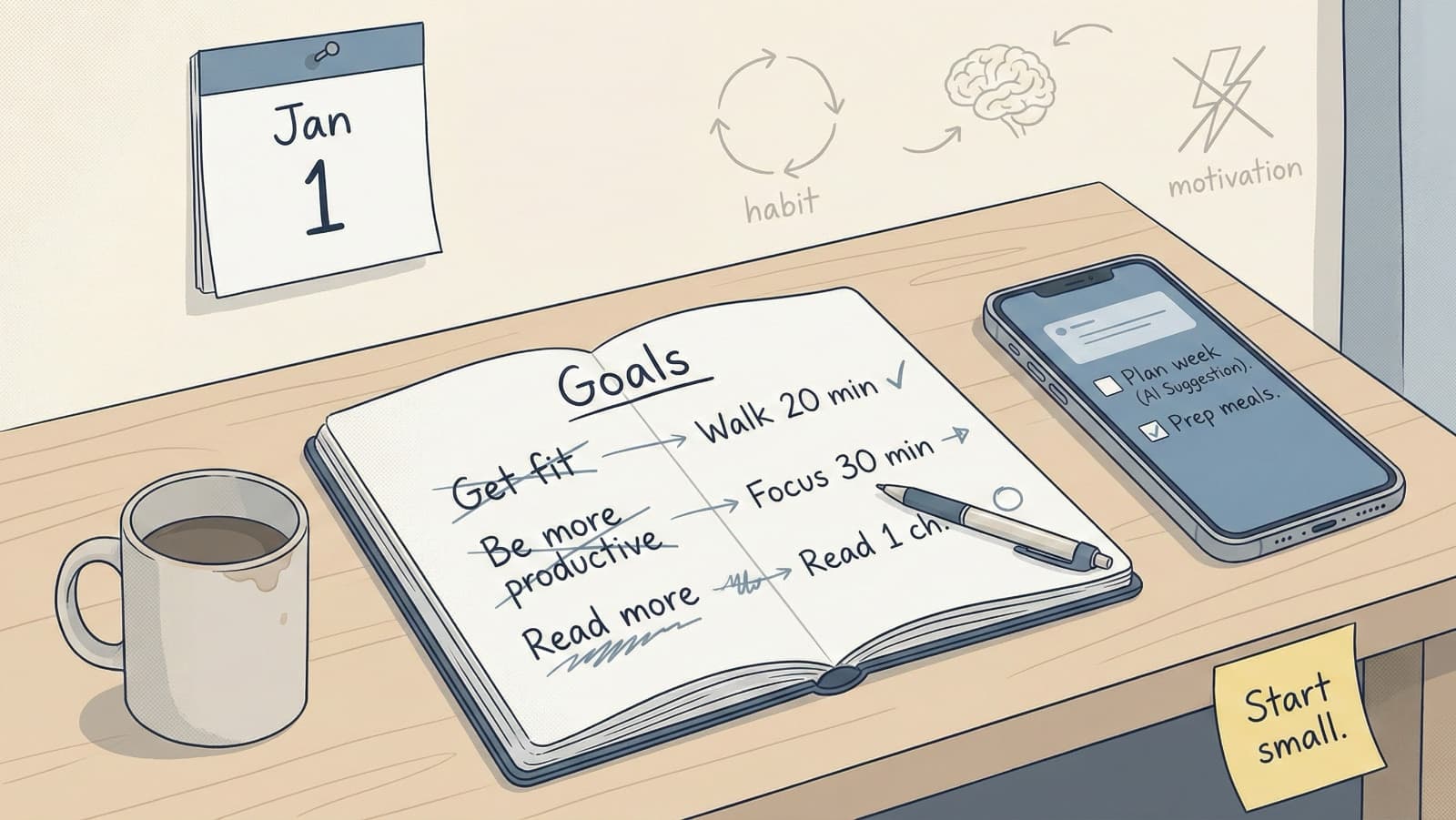
We’re going to take nice, socially acceptable goals like:
- “Write a book”
- “Get in shape”
- “Fit into a bikini by March”
…and turn them into things that sound far less impressive.
On purpose.
Because impressive-sounding goals are terrible at surviving exhaustion, low motivation, bad weeks, and regular human existence.
Instead, we design systems that still work when you’re tired, busy, cranky, or would rather do literally anything else.
That’s not lowering the bar. That’s finally putting the bar somewhere you can actually climb over.
Before You Paste Anything into AI, Read This Once
Resist the urge to immediately copy-paste. Scan the principles below first — not to memorize them, just to notice the pattern:
- identity over outcomes
- systems over motivation
- friction removal over discipline
These aren’t productivity tips. They’re constraints for building habits that survive reality.
If you want to go deeper, links to the original researchers are at the end.
The 14 Best Practices for Personal Goal Design
1. Design goals around identity + process, not outcomes
Core insight:
The brain does not reliably execute abstract outcomes. It executes repeatable behaviors tied to identity.
Bad
“I want to get fit.”
Better
“I am the kind of person who trains 4 days a week, even when motivation is low.”
How to apply
- Define the identity: “I am someone who…”
- Define the process: what you do, on which days/times
- Treat outcomes (weight, revenue, milestones) as lagging indicators
- Dopamine is released by progress signals, not distant wins.
2. Make goals binary at the action level
Core insight:
Your nervous system prefers clear success/failure signals.
Bad
“Write more this year.”
Good
“Write 300 words before checking email.”
How to apply
- Daily/weekly actions should be yes / no
- Avoid ranges (“30–60 minutes”) unless you specify a minimum
- Define a minimum viable win that works on bad days
- This reduces cognitive load and decision fatigue.
3. Separate goals into three layers
Core insight:
Motivation collapses when you judge yourself on things you don’t fully control.
Layer 1 — Behavioral (fully controllable)
What you do
When you do it
How often
Layer 2 — Performance (partially controllable)
Pace, quality, intensity
Metrics that improve with consistency
Layer 3 — Outcome (not directly controllable)
Promotions, income, recognition, aesthetics
Rule
Only emotionally evaluate yourself on Layer 1.
This prevents dopamine crashes.
4. Attach goals to specific time & context
Core insight:
The brain executes contextual scripts, not intentions.
Weak
“I’ll meditate more.”
Strong
“I meditate for 10 minutes immediately after brushing my teeth at 6:30am.”
How to apply
-
Anchor goals to:
- A time
- A location
- A preceding action (habit stacking)
-
This makes behavior near-automatic.
5. Use dopamine wisely (don’t reward outcomes)
Core insight:
Rewarding outcomes trains your brain to wait; rewarding effort trains it to act.
Do NOT
- Reward yourself only when the big goal is achieved
- Constantly visualize the end state
Do
- Reward effort and consistency
- Acknowledge completion of the process
Example
“I get a dopamine hit for showing up, not for results.”
6. Build in friction removal, not willpower
Core insight:
Willpower is finite. Environment is leverage.
How to apply
-
Remove friction before you start:
- Clothes laid out
- Apps blocked
- Calendar pre-scheduled
-
Add friction to undesired behaviors:
- Extra steps
- Password barriers
- Delayed access
-
Environment beats discipline over time.
7. Use short time horizons with renewal
Core insight:
The brain works best in cycles, not infinite commitments.
Instead of
“My 2025 resolution is…”
Try
- 30-day or 6-week “seasons”
- Explicit review/reset points
Review questions
- What stayed easy?
- What felt heavy?
- What should be simplified?
8. Track streaks, not totals
Core insight:
Dopamine is highly sensitive to continuity.
How to apply
-
Track:
- Consecutive days
- Consecutive weeks
-
Misses = data, not failure
-
Restart immediately — no “I blew it” stories
9. Explicitly plan for low-motivation days
Core insight:
Goals fail on bad days, not good ones.
Ask in advance
“What does success look like on my worst day?”
Examples
- Gym day → walk + stretch
- Writing day → one paragraph
- Learning day → 5 minutes
Consistency beats intensity.
10. Limit yourself to 1–3 primary goals
Core insight:
Cognitive bandwidth is real.
Best practice
- 1 identity goal
- 1 physical / energy goal
- 1 creative or professional goal
Everything else becomes a supporting habit, not a headline resolution.
11. Visualize obstacles, not success
Core insight:
Visualizing success often reduces effort. Visualizing difficulty increases persistence.
How to apply
-
Mentally rehearse:
- Where it will get hard
- What you will do anyway
Example
“It’s late, I’m tired — I open the doc and write one paragraph.”
This is rehearsal, not fantasy.
12. Frame goals as approach, not avoidance
Core insight:
Avoidance framing increases anxiety and narrows attention.
Avoid
- “Stop procrastinating”
- “Don’t fail”
Use
- “Start with a 5-minute draft”
- “Move toward consistency”
Always frame goals as moving toward something.
13. Actively author your identity narrative
Core insight:
Old identity stories reassert themselves under stress.
How to apply
-
Write:
- Old identity story
- New identity story
Example
- Old: “I work best under pressure.”
- New: “I create space early so pressure is optional.”
Identity alignment prevents relapse.
14. Narrow the perceived distance to the goal
Core insight:
Goals that look closer receive more effort.
How to apply
- Break work into visually small steps
- Avoid dashboards that emphasize how far remains
Example
- Bad: “Write a book”
- Good: “Draft section 2.1 (400 words)”
Progress should feel near.
Final mental model
Goals are not promises to your future self.
They are systems that make the right behavior the easiest behavior today.
The Exact Prompt to Use
OK, NOW you can finally take the final step…
Copy and paste this into your AI of choice adding in your original goals and all 14 principles as shown below (and yes, keep the starting and ending triple quotes. Don’t ask. Just trust.):
Please take my original goals and rework them into a habit-based system using the following 14 principles of goal and habit design.
Focus on:
identity-aligned behaviors
small, repeatable actions
habits that work even on low-motivation days
frequencies that make sense (daily, weekly, or a few times per week)
systems that naturally lead to the original outcomes over time
Here are the 14 principles:
"""
[PASTE THE COMPLETE TEXT OF 14 PRINCIPLES ABOVE HERE INCLUDING ALL EXAMPLES]
"""
Here are my original goals:
"""
[PASTE YOUR ORIGINAL GOALS HERE]
"""
Then let the AI quietly dismantle your bad assumptions.
What Actually Changed (And Why This Works)
Here’s the part that most people miss the first time through.
You’re not deleting your goals — although the first time I tried this, it absolutely felt that way. Watching nice, clean goals get broken down into small, unglamorous behaviors can feel a bit like vandalism. That reaction is normal.
What’s actually happening is more interesting. You’re replacing a fragile, motivation-dependent plan with a system that keeps working whether you feel inspired or not.
At this point, you’ve taken the traditional goals the AI helped you articulate and the 14 principles that describe how humans actually behave, and you’ve asked the AI to re-architect everything into a habit system that doesn’t require heroics, discipline marathons, or January-only enthusiasm.
That shift is subtle, but it’s the whole game.
Instead of waking up every day asking, “Do I feel motivated enough to chase this goal?”, you’ve built a system where the next right action is already decided, already scoped, and already small enough to execute even on your worst days.
This isn’t about grinding harder. It’s about making progress unavoidable.
Follow the habits long enough and something strange happens: you stop thinking about the goal altogether. Then one day you look up and realize the thing you were chasing quietly got finished — without drama, without burnout, and without a single motivational speech.
“Oh. Huh. I guess I did the thing.”
That’s not magic. That’s design.
Final Thought
Goals fail because they demand motivation.
Systems succeed because they don’t care how you feel.
Use AI to design the system. Let the outcomes show up when they’re ready.
Sources & Further Reading
- BJ Fogg — Behavior Design & Tiny Habits https://www.behaviormodel.org https://tinyhabits.com
- Michael Gervais — Performance Psychology & Process Orientation https://findingmastery.com
- Emily Balcetis — Motivation, Perception, and Goal Distance https://www.hubermanlab.com/episode/dr-emily-balcetis-tools-for-setting-and-achieving-goals
- Maya Shankar — Identity, Narrative, and Behavior Change https://www.hubermanlab.com/episode/dr-maya-shankar-how-to-shape-your-identity-and-goals
- Andrew Huberman — Neuroscience of Motivation, Dopamine, and Effort https://www.hubermanlab.com https://www.hubermanlab.com/episode/the-science-of-setting-and-achieving-goals