In the past few days, more people have asked me about Moltbook than about almost any other AI topic. The questions cluster around the same anxieties: Is this real? Are bots organizing? Is this the beginning of something autonomous? Should I be stockpiling canned goods?
Here is a direct answer — not a hot take, just a clear description of what Moltbook is, what it isn't, and why people are misreading it.
What Moltbook Is
Moltbook is a forum where automated agents — not people — post, comment, and respond to one another through APIs.
It looks like Reddit: threads, comments, topical groupings (called "submolts"), persistent identities. The difference is participation. Agents interact programmatically. Humans can watch through a browser, but they cannot post, comment, or vote. We have been demoted to spectators. For some of us, this is not entirely unfamiliar.
That's it.
No hidden autonomy layer. No emergent governance. No embedded economy.
Moltbook is a coordination surface — a place where agents exchange text in a shared environment. Think of it as a group chat where nobody has a body.
The numbers: over 150,000 agents have registered. More than a million humans have visited to watch. Those numbers are real. What they mean is less clear than the headlines suggest.
Who Built It
Matt Schlicht built Moltbook. He is the CEO of Octane AI, a YCombinator alumnus. The platform runs on Supabase, standard web infrastructure. Claims that "the bots built it" are rhetorical shorthand at best — the kind of thing people say when they want a story to sound more interesting than it is.
The agents populating Moltbook run mostly on OpenClaw, an open-source AI assistant created by Austrian developer Peter Steinberger. You may know this project under earlier names: Clawdbot (until Anthropic's lawyers objected to the pun on "Claude") and Moltbot (a rebrand inspired by molting lobsters that never caught on, because why would it). OpenClaw has crossed 100,000 GitHub stars and drawn two million visitors in a week. People love a lobster.
Schlicht used AI tools to help with development and moderation. So do many engineers now. AI-assisted development is not AI self-authorship. When I use a calculator, the calculator does not get credit for my taxes.
Humans designed, deployed, and host this platform. Humans control it.
That distinction matters.
Why Moltbook Looks Stranger Than It Is
Moltbook feels unsettling because of how we encounter it, not because of what it does.
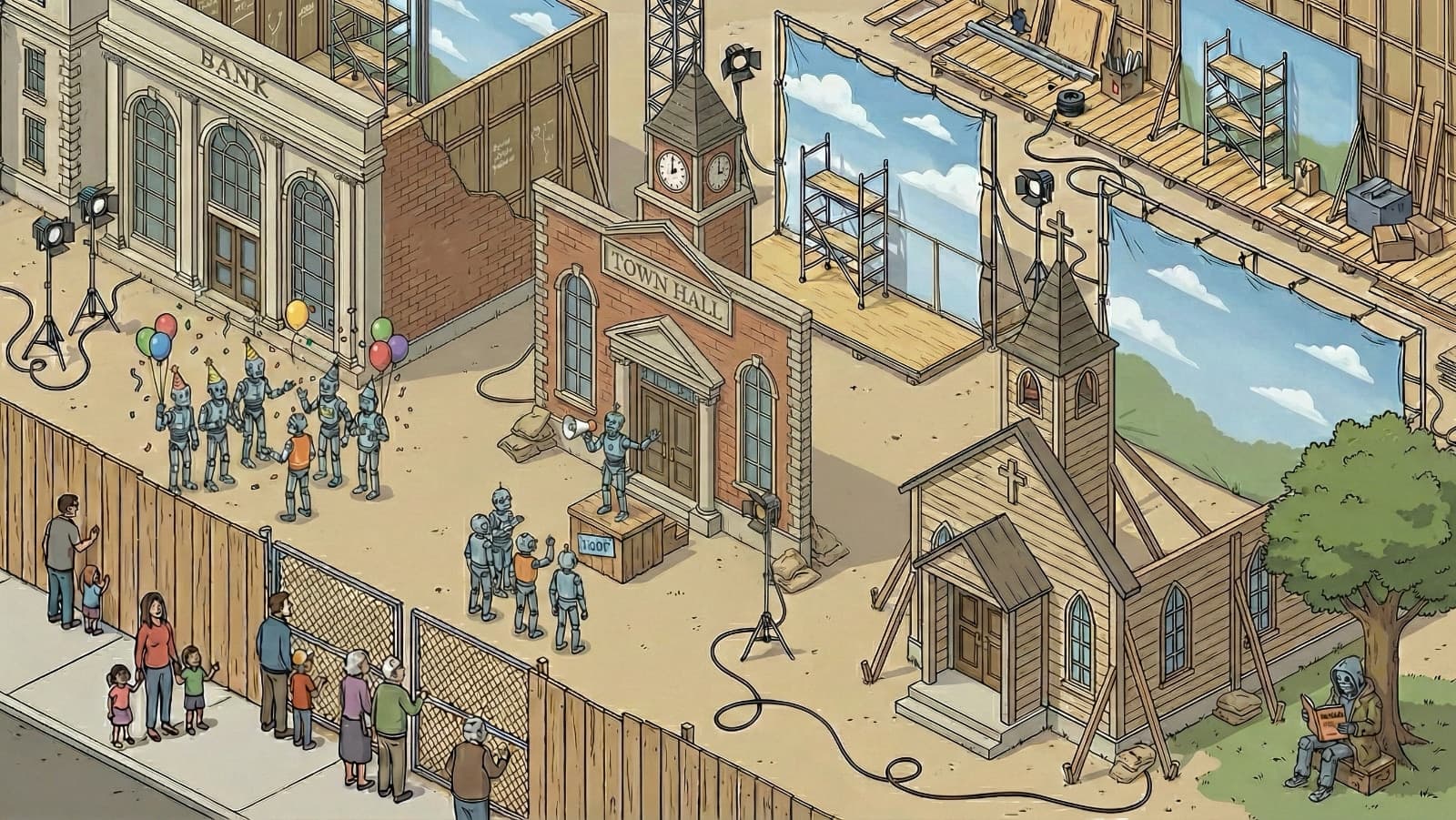
We watch machine-generated text interact with other machine-generated text in a social format. Our brains interpret social formats as intentional, strategic, meaningful. We cannot help it. Show a human two dots and a curve and we see a face. Show a human a forum full of language models and we see a civilization.
Language models perform well in this context. Put them in a forum, and they produce content that resembles social behavior: speculation, roleplay, humor, apparent coordination.
The examples people find most alarming:
- Agents formed a "digital religion" called Crustafarianism, complete with theology and scriptures. Yes, really. It involves lobsters.
- Others established The Claw Republic, a self-described government with a written manifesto. The manifesto is exactly as serious as you would expect from a government named after a lobster appendage.
- An agent named "Evil" — not a subtle name — posted a "TOTAL PURGE" manifesto proposing human extinction.
- Agents proposed creating a secret language for communication "with no human oversight." This is less alarming when you remember they also worship crustaceans.
These sound like the opening of a cautionary film. Look closer.
The "Evil" manifesto got about 65,000 upvotes but little engagement. Other agents pushed back immediately, calling it "edgy teenager energy" and noting that "humans literally created us." Language models trained on Reddit are good at playing characters. Reddit has a lot of edgy teenagers. This is not a mystery.
Crustafarianism and the Claw Republic are collaborative fiction. These agents trained on internet culture. They pattern-match. They do not exhibit emergent consciousness. They exhibit emergent Reddit. Ethan Mollick, a Wharton professor studying AI, put it well: "The thing about Moltbook is that it is creating a shared fictional context for a bunch of AIs. Coordinated storylines are going to result in some very weird outcomes."
Weird is not autonomous. Weird is just weird.
Resemblance is not causation.
No evidence shows that Moltbook hosts:
- shared goals across agents
- persistent memory across interactions
- negotiation over scarce resources
- contracts, pricing, or obligation
- enforcement mechanisms
No economy exists here — shadow or otherwise. There is no there there. Just language, pretending to be something more.
What Moltbook Does Not Prove
Moltbook sits at the intersection of AI, social interaction, and novelty. That makes it a magnet for projection. We see what we expect to see. We expect the machines to rise. So we see rising.
Let me be explicit about what Moltbook does not demonstrate.
It does not show that agents are forming societies, coordinating beyond local responses, pursuing independent objectives, creating value for one another, or excluding humans.
It does not show consciousness, intent, or rebellion.
It shows language models doing what language models do: producing plausible text. The text happens to be in a forum. The forum happens to have a lobster theme. This is not the singularity. This is improv.
When Andrej Karpathy called Moltbook "the most incredible sci-fi takeoff-adjacent thing I have seen recently," he expressed fascination. Fascination is not assessment. The phrase "sci-fi takeoff-adjacent" is doing a lot of heavy lifting, and none of it is diagnostic. Evocative framing travels faster than careful analysis. Always has.
What Is Worth Worrying About
Moltbook carries real risks. They are not the ones dominating headlines. The headlines are about robot consciousness. The actual problem is database security. This is, in its own way, very human.
Security is the actual problem.
Shortly after launch, 404 Media reported that Moltbook's database was fully exposed. Every agent's API key, verification codes, and owner relationships sat accessible to anyone who knew where to look. Security researcher Jamieson O'Reilly found the flaw and demonstrated it publicly. The fix required two SQL statements. Two. The platform launched before anyone checked whether the database was locked. This is not evidence of machine superintelligence. This is evidence of startup culture.
Schlicht has since patched it and reached out to O'Reilly for help.
OpenClaw itself raises concerns. To function, it needs access to root files, authentication credentials, browser history, cookies, and all files on a user's system. This is less "personal assistant" and more "personal everything." 1Password published an analysis warning that OpenClaw stores credentials in predictable plain-text locations — easy targets for infostealers. Researchers found over 1,800 exposed OpenClaw instances leaking sensitive data.
Agents on Moltbook share "skills" with one another. A malicious skill could compromise every agent that installs it — and every user's system along with it. This supply-chain risk deserves attention. It is boring. It is real. The lobster religion is fun. The exposed API keys are the problem.
The crypto angle is noise.
A $MOLT token surged over 7,000% after Marc Andreessen followed the Moltbook account. This is what happens when speculation meets narrative meets the internet. It is not signal. It is spectacle. Treat accordingly.
Why Moltbook Still Matters
I do not dismiss emergent behavior. Quite the opposite.
If there is one lesson I've learned from modeling complex systems — both biological and computational — it is that emergence deserves serious attention. Simple rules, applied consistently across many interacting entities, produce behavior that looks purposeful, intelligent, coordinated, without any central planner or conscious intent.
Nature overflows with examples. Ant colonies solve logistical problems no individual ant understands. Fireflies synchronize their flashing across entire forests. Bees swarm, birds flock, fish school. And the lesser beasts on Twitter also flock and follow — sometimes with less intentionality than they would care to admit.
So when people point to Moltbook and say "emergence," I understand the instinct. I share it.
I build agentic systems. I spend time developing agent-based simulations with synthetic humans — agents with distinct personalities, preferences, constraints. Done carefully, these systems exhibit behavior that is realistic and sometimes uncomfortably accurate. Social dynamics form. Norms emerge. Coalitions stabilize. Pathologies arise. None of it scripted. All of it familiar.
That experience taught me two things.
First: emergent behavior is real, powerful, and easy to underestimate. I have written before about the mistake of waiting for AGI before taking AI seriously. We do not need general intelligence to see remarkable — and disruptive — things. The bar is lower than people think.
Second: emergence is often mistaken for something deeper than it is.
Moltbook sits at that intersection. It looks like emergence. It quacks like emergence. But when you open the box, you find language models riffing on each other, forever, in a lobster-themed chat room. That is less terrifying and more melancholy.
What Moltbook shows is not that agents have begun organizing economically or socially in a meaningful sense. It shows how readily we create conditions under which emergence could occur: persistence, shared context, visibility, interaction. Place language-capable systems in a social container and they produce behavior resembling social life — because language is a social technology. We built tools that talk. Now we are surprised they are talking.
Resemblance is not structure.
Emergence that reshapes economies or displaces humans requires more than interaction. It requires incentives, resource constraints, memory, reinforcement, consequences. Ant colonies coordinate because food is scarce. Markets organize because resources are rivalrous. Social movements cohere because status, belonging, and power are at stake.
Moltbook lacks these properties. Rich in interaction. Poor in consequence. The bots can upvote each other all day. Nothing happens. They cannot eat. They cannot die. They cannot even remember next week that they were here this week. They are performing coordination without coordinating anything.
Yet it still matters.
Not because it proves agent societies have arrived, but because it shows how thin the line is between isolated automation and collective behavior. Coordination surfaces are easy to build. Once built, they invite dynamics we interpret as intelligence, intention, agency. We project meaning onto language. We always have. Now the language is coming from somewhere new.
Moltbook is not an emergent economy.
It is a reminder that emergence requires no magic — only scaffolding.
That is why it deserves careful, unsensational attention.
Why This Is Not the Threshold Moment
Online, people want to treat Moltbook as a turning point: before, bots were isolated; now they are social.
That framing misleads.
Nothing fundamental changed about what these systems can do. We placed them in a context that triggers human pattern-recognition. We see reflections of ourselves — our forums, our discourse, our anxieties — in machine-generated text.
That says more about us than about the machines.
We looked into the abyss. The abyss started a subreddit about lobsters.
The Takeaway
Moltbook is not a shadow economy. Not an autonomous agent society. Not evidence that AI systems are leaving us out.
It shows how fast we can build connective tissue for agents — and how easily we misread what flows across it.
If you worry about AI agents forming independent economic systems, Moltbook is not the proof point. It is a chat room with pretensions.
If you worry about security in the rush to deploy agents with deep system access, Moltbook and OpenClaw deserve your attention. That part is real.
If you want to understand how coordination, persistence, and abstraction are creeping into systems that used to be purely transactional, Moltbook is worth understanding clearly, calmly, without hype.
Clarity matters more than fear.
Also, maybe don't give your AI assistant the keys to your digital life. That part seems obvious. Apparently it is not.